Does butter have lactose? Butter, yogurt, kefir, and ice cream, compared
Butter barely has any. Greek yogurt has less than you’d think. Kefir has more than you’d hope. Here’s the rest of the fridge, with real numbers.
Short answer: butter has a little lactose, about 0.1 g per tablespoon, and ghee has almost none. Greek yogurt has less than regular yogurt but isn’t lactose-free. Kefir, buttermilk, and ice cream carry the most of anything here. Milk still tops them all at about 12.6 g a cup.
Lactose in butter, yogurt, and cream, food by food
Per-serving values for ice cream, yogurt, Greek yogurt, kefir, buttermilk, and milk are from the National Dairy Council chart (USDA data). Values marked “about” are the per-100 g figure scaled to the serving weight shown. Per-100 g values are from Facioni et al. (2020), USDA FoodData Central, and, for ghee and the low end of butter, Portnoi & MacDonald (2015). Brands vary, so treat these as typical rather than exact.
Does butter have lactose?
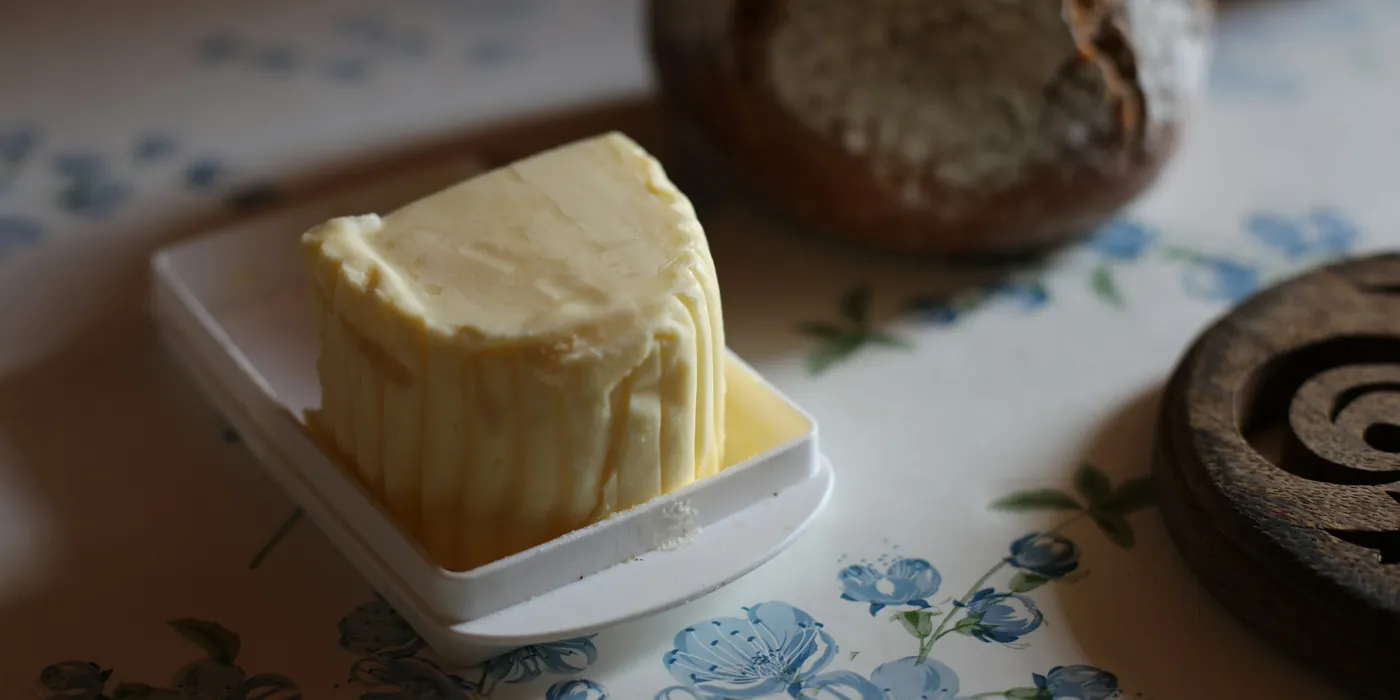
Yes, but very little. Butter is churned from cream, and churning splits it into butterfat and buttermilk. Lactose dissolves in the watery part, so most of it leaves with the buttermilk. What’s left measures roughly 0.7 to 1.1 g per 100 g, or about 0.1 g in a tablespoon you’d spread on toast.
Where butter adds up is in volume. A few pats at breakfast is very little lactose. A whole cup of butter in a recipe works out to roughly 2 g, which is still well under the 12.6 g in a glass of milk.
Is ghee lactose-free?
Close enough that the difference is academic. Ghee is butter simmered until the water evaporates and the milk solids are strained out. A lab analysis of ghee samples measured under 3 mg of lactose per 100 g, against roughly 690 mg in the butter tested alongside it. That’s a trace, not a meaningful amount.
Is Greek yogurt lactose-free?
No, but it’s one of the lower-lactose dairy foods you can eat by the bowl. Greek yogurt is strained to make it thick, and the liquid whey that drains off takes some of the lactose with it. A 3/4 cup serving has about 4.2 g, against about 5.7 g for the same amount of regular yogurt.
The per-100 g numbers vary more than you’d expect: from about 0.5 g in an Italian food database to 2.4–2.9 g in USDA data. How long a yogurt is strained, and how it’s made, changes the result. If you’re comparing plain, unsweetened tubs, the sugars line on the nutrition label works as a rough upper limit, since there’s no added sugar for it to count.
Yogurt also has something milk doesn’t: live cultures. The bacteria in yogurt break down some of its lactose, which is part of why a lot of people who avoid milk do fine with yogurt.
What about skyr?
Skyr is a strained yogurt too, so it belongs in the same lower-lactose group as Greek yogurt. It isn’t lactose-free unless the label says so.
Is kefir lactose-free?
No. Kefir is fermented, and fermentation uses up some lactose, but a cup still has about 8.5 g. That’s around two-thirds of a cup of milk, and more than any yogurt on this list. Kefir is usually drunk by the glass, so the serving is bigger too.
Lactose-free kefir does exist. It’s made the same way as lactose-free milk, with lactase enzyme added to break the lactose down.
Cream, sour cream, and cream cheese
Gram for gram, these sit in the middle: around 3 to 4 g per 100 g. The serving is what keeps them small. A tablespoon of whipping cream or a dollop of sour cream is well under a gram of lactose.
- Whipping cream (35%) has the least of the creams, about 2.9 g per 100 g, because more of it is fat.
- Half-and-half (10% cream) has more, about 4.1 g per 100 g, because more of it is milk. A splash in coffee is small. Three creamy coffees a day is not.
- Sour cream and cream cheese are about 3.4 and 3.8 g per 100 g. A schmear on a bagel is around a gram. A cheesecake is a different conversation.
Does ice cream have lactose?
Yes. Ice cream is made from milk and cream with nothing to break the lactose down, so a 2/3 cup serving has about 3.9 g. Bowls are rarely 2/3 of a cup.
- Gelato is made with milk, so it isn’t lactose-free.
- Frozen yogurt isn’t lactose-free either.
- Sorbet is usually made without dairy. Sherbet usually has some milk in it. Check the label on both.
Is goat milk lower in lactose?
Not really. Goat milk has about 4.7 g of lactose per 100 g, next to about 4.9 g for cow’s milk. If milk bothers you, goat milk usually will too. Goat cheese is a different story; aged ones follow the same pattern as other cheeses. (How much lactose is in cheese, cheese by cheese.)
What this means at the table
Everyone’s line is different. Some people notice a splash of cream; plenty never notice anything short of a milkshake. If dairy only catches you sometimes, the total for the meal is usually the reason, not one ingredient. A latte, a yogurt, and a scoop of ice cream in one day add up to more than any one of them.
- Butter and ghee are rarely the issue. If a buttery dish bothers you, look at the cream or milk that came with it.
- Greek yogurt over regular, regular over kefir if you’re choosing by lactose.
- Watch the volume foods. Kefir, buttermilk, ice cream, and milky coffees are drunk or eaten by the cup. The lactose intolerance diet guide covers how to find your own threshold.
- For dairy you don’t choose, like dessert at someone else’s place, a lactase enzyme taken with the first bite helps with the dairy you’re eating at that moment. (How lactase pills work.)
One more thing: this page is about lactose, the sugar in milk. Ghee and butter being low in lactose says nothing about milk proteins, so none of it applies to a milk allergy. (How the two differ.)
FAQ
Does butter have lactose?
A little. Butter measures roughly 0.7 to 1.1 g of lactose per 100 g, so a tablespoon carries around 0.1 to 0.15 g. A cup of milk has about 12.6 g. Most of milk’s lactose leaves with the buttermilk when butter is churned.
Is ghee lactose-free?
Close to it. Ghee is butter with the water and milk solids cooked off, and one lab analysis measured under 3 mg of lactose per 100 g. That’s hundreds of times less than butter. It isn’t always labelled lactose-free, but the amount is a trace.
Is Greek yogurt lactose-free?
No, but it has less than regular yogurt. Straining removes some of the whey, and lactose goes with it. Measured values range from about 0.5 to 2.9 g per 100 g depending on how it’s made, and a 3/4 cup serving comes in around 4.2 g, compared with about 5.7 g for regular yogurt.
Is kefir lactose-free?
No. Fermentation uses up some of the lactose, but a cup of kefir still has around 8.5 g, roughly two-thirds of what a cup of milk carries. Lactose-free kefir, made with added lactase, is a separate product.
Does ice cream have lactose?
Yes. A 2/3 cup serving has about 3.9 g. Gelato and frozen yogurt are made with milk too, so they aren’t lactose-free either. Sorbet is usually dairy-free, but check the label.
Is goat milk lactose-free?
No. Goat milk has about 4.7 g of lactose per 100 g, almost the same as cow’s milk at about 4.9 g. Switching to goat milk doesn’t meaningfully lower lactose.
Which dairy has the least lactose?
Ghee, then butter and aged hard cheeses like parmesan. After those come small amounts of cream, Greek yogurt, and soft cheeses. Milk, buttermilk, and kefir carry the most per serving.
Sources
- Facioni MS et al., Nutritional management of lactose intolerance: the importance of diet and food labelling, Journal of Translational Medicine 18:260 (2020) (Table 1: lactose per 100 g for butter, yogurt, Greek yogurt, sour cream, buttermilk, goat milk, milk)
- National Dairy Council, Enjoy Dairy Foods with Confidence (2023) (lactose per serving, from USDA FoodData Central)
- Portnoi PA, MacDonald A, The lactose and galactose content of milk fats and suitability for galactosaemia, Molecular Genetics and Metabolism Reports 5:42–43 (2015) (ghee and butter)
- USDA FoodData Central, SR Legacy: cream cheese (173418), heavy whipping cream (170859), half and half (171255), plain lowfat kefir (170904), plain Greek yogurt (170903, 171309)
- NIDDK: Eating, Diet, & Nutrition for Lactose Intolerance
Written and fact-checked by the Lackees editorial team against the sources cited above, following the standards we write by. This article is for general information and isn’t medical advice. It isn’t reviewed by a physician, pharmacist, or registered dietitian. Talk to a healthcare provider about symptoms or before starting any supplement. Lackees is a chewable lactase product that’s pre-launch and pending Health Canada Natural Health Product review; nothing here is a claim about an approved or available product.